Order Picker vs Reach Truck Summary
- Order pickers and reach trucks are both OSHA Class II powered industrial trucks, but they are different types of equipment.
- OSHA requires separate, equipment-specific training for each type under 29 CFR 1910.178. One Class II certification does not cover both.
- Order pickers lift the operator up with the load to pick individual items from racking. Reach trucks keep the operator at floor level and extend forks into racking to move full pallets.
- All training must include classroom instruction, hands-on practical evaluation, and a workplace performance check on the actual equipment the operator will use.
- Bottom line: if your operators work both machines, they need to be certified on both, and online-only programs are not OSHA compliant.
Florida warehouses, distribution centers, and retail backrooms run on narrow-aisle equipment. From the Port of Miami to the cold-storage facilities outside Tampa, two trucks dominate vertical storage operations: the order picker and the reach truck. They look related, share an OSHA classification, and often work in the same aisle. Yet they handle differently, carry different risks, and, most importantly for safety managers, require different certifications.
The confusion costs companies money in failed OSHA inspections and, worse, contributes to preventable injuries. Many employers assume that a forklift operator who is certified on one piece of Class II equipment can legally operate any Class II truck. That is not what the regulation says, and it is not how the standard is enforced.
This guide breaks down the real differences between order pickers and reach trucks, what OSHA actually requires for each, and how Florida employers can get their operators properly certified on every machine in their fleet.
What Is an Order Picker?
An order picker, sometimes called a stock picker or cherry picker (not to be confused with the boom-type aerial cherry picker) — is a narrow-aisle electric truck designed for individual case picking. The defining feature is simple: the operator platform rises with the forks. The operator stands on a small elevated platform, wears a full-body harness with a fixed lanyard, and travels up to 30 feet or higher into racking to retrieve individual items.
Order pickers are the workhorses of e-commerce fulfillment, parts distribution, and retail distribution centers. If you have walked into a major distribution facility in Lakeland, Jacksonville, or Orlando, you have seen them weaving through narrow aisles with an operator standing 15 to 25 feet in the air.
Where You’ll See Order Pickers
- E-commerce fulfillment centers
- Parts and components warehouses
- Retail distribution (apparel, footwear, packaged goods)
- Hardware and home improvement back-of-house operations
- High-bay archive and document storage
Key Operating Risks
Because the operator travels up with the load, fall protection is non-negotiable. The most common serious incidents involve operators stepping off the platform at height, getting struck by falling product, or tipping the unit by reaching outside the platform. Operators must understand load stability, harness use, and how to position the truck so picks can be made without leaning or stretching.
What Is a Reach Truck?
A reach truck is a narrow-aisle electric forklift built for put away and retrieval of full pallets in racking. Unlike an order picker, the operator stays at ground level, usually in a side-stance compartment, and uses a hydraulic mechanism that extends the forks (the “reach”) forward into the rack. The mast itself can lift loads 30 to 40 feet up, but the operator does not go up with it.
Reach trucks are the standard equipment for pallet-in, pallet-out warehouse operations. They thrive in tight aisles where a traditional sit-down forklift cannot maneuver, which is exactly the environment most modern Florida distribution centers are designed around.
Where You’ll See Reach Trucks
- High-density pallet storage warehouses
- Cold storage and freezer facilities
- Manufacturing inbound and finished-goods areas
- Grocery distribution centers
- Beverage and bottling distribution
Key Operating Risks
The biggest risks are different from those of an order picker. Operators need to manage extended-mast load stability, watch for racking collisions at height, control sway when the mast is fully raised, and stay aware of pedestrians who often cross paths in narrow aisles. Side-stance ergonomics also create blind spots that require deliberate scanning before every move.
Order Picker vs Reach Truck: Side-by-Side Comparison
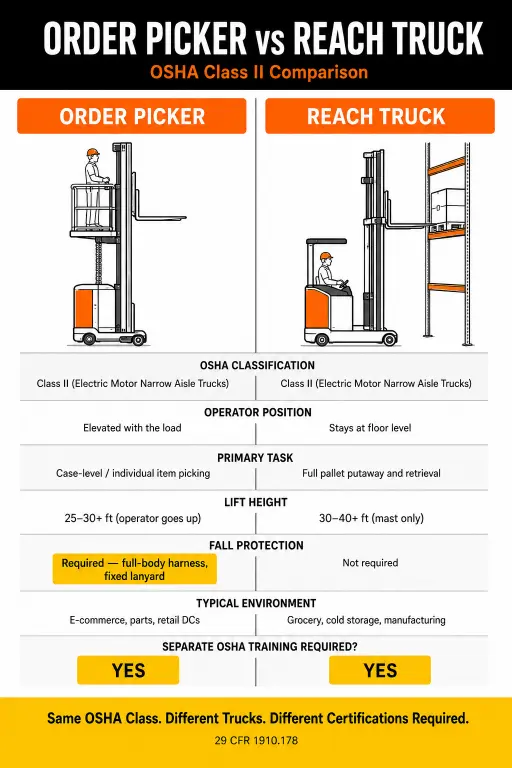
The shared Class II label is what trips most people up. Class II is a classification of trucks, not a single skill set. OSHA’s training rule cares about the specific type of truck — and order pickers and reach trucks handle, balance, and fail in genuinely different ways.
OSHA Certification Requirements for Both
The federal rule that governs all powered industrial truck operation is 29 CFR 1910.178, with the training-specific requirements in subsection (l). The standard sets out three elements that every certified operator must complete:
- Formal instruction — lecture, video, written materials, or computer-based learning covering truck-related and workplace-related topics.
- Practical training — hands-on demonstrations performed by the trainer and practical exercises performed by the trainee on the specific equipment.
- Evaluation — the operator’s performance must be evaluated in the workplace on the actual truck they will be assigned to operate.
That third element is where many programs fall short, and where OSHA citations land.
Why One Class II Certification Doesn’t Cover Both
OSHA addresses this directly in 29 CFR 1910.178(l)(3)(i)(B), which lists “differences between the truck and the automobile” and “truck controls and instrumentation” as required truck-related training topics, followed by engine or motor operation, steering and maneuvering, visibility, capacity, stability, and all other operating characteristics of the specific truck.
OSHA has reinforced this in multiple standard interpretation letters: if the controls, capacity, stability characteristics, or operating environment of one truck differ from another, training and evaluation must be conducted on each truck the operator will use. An order picker and a reach truck are not the same truck, they are not even operated from the same body position. Cross-training is not optional.
What Equipment-Specific Training Must Cover
For both order pickers and reach trucks, training must address:
- Truck controls, instrumentation, and pre-operational inspection
- Steering, maneuvering, and visibility limitations
- Fork or platform elevation, load handling, and load stability
- Vehicle capacity and stability characteristics (the stability triangle behaves differently for each)
- Refueling or battery charging procedures
- Workplace-specific topics: aisle widths, surface conditions, pedestrian traffic, racking layouts, hazardous areas
- Operating in narrow aisles and confined spaces
You can read more about how this works in our forklift operator certification guide.
Which Certification Does Your Operator Actually Need?
The honest answer for most Florida warehouses: probably both. Here is a quick decision framework.
You Need Order Picker Certification If…
- Your operators lift themselves up to pick individual cases, boxes, or items from rack
- You run an e-commerce, parts, or piece-pick operation
- Your team works with the operator platform elevated above floor level
- You use any equipment classified by the manufacturer as a stock picker, order picker, or operator-up truck
You Need Reach Truck Certification If…
- Your operators move full pallets in and out of racking
- You run narrow-aisle pallet storage (8–10 foot aisles or tighter)
- Your equipment has an extending hydraulic reach mechanism
- Your operators work standing in a side-stance compartment with the mast in front of them
You Need Both If…
- Operators rotate between picking and putaway tasks
- Your facility runs mixed operations (cases and pallets through the same aisle network)
- Cross-training is part of your workforce flexibility plan
Operators who run both machines need to be evaluated and certified on each one, and certification records must reflect both pieces of equipment.
Florida Industries Where This Matters Most
Florida’s logistics footprint is enormous and growing. The state’s distribution and warehousing industries depend heavily on Class II equipment, which makes the order picker / reach truck distinction a common compliance gap during OSHA inspections.
- Port operations in Miami, Jacksonville, and Tampa rely on reach trucks for high-density import storage.
- E-commerce fulfillment along the I-4 corridor (Orlando, Lakeland) runs heavy order picker fleets.
- Grocery distribution in Central and South Florida uses reach trucks in refrigerated and freezer racking.
- Agricultural packing and cold storage in Homestead, Plant City, and the Indian River region use both, depending on whether product moves by pallet or by case.
- Big-box retail back-of-house across the state runs mixed Class II environments.
Because Florida Forklift Safety Training delivers all training on-site at your facility, your operators are evaluated on your equipment in your aisles, which is exactly what OSHA’s workplace performance evaluation requires.
Frequently Asked Questions
What is the difference between an order picker and a reach truck?
The operator’s position. On an order picker, the operator rides up with the forks to pick individual items at height. On a reach truck, the operator stays at floor level while the mast and forks extend into the racking to handle full pallets. Both are OSHA Class II narrow-aisle trucks, but they perform different jobs and require different skills.
Do I need separate certifications for an order picker and a reach truck?
Yes. OSHA requires training and evaluation on the specific type of truck an operator will use. Even though both are Class II equipment, the controls, stability characteristics, fall protection requirements, and operating procedures are different enough that one certification does not transfer to the other.
Are order pickers and reach trucks the same OSHA class?
Both are classified as Class II — Electric Motor Narrow Aisle Trucks — under OSHA’s powered industrial truck categories. Class II also includes side-loaders and turret trucks. The shared classification does not mean shared certification; each truck type still requires its own training and evaluation.
How often does a reach truck or order picker operator need to be recertified?
We recommend recertification every two years as a safety best practice. Three-year renewals are available upon request. OSHA’s minimum legal requirement is an evaluation at least every three years, plus refresher training after any accident, near miss, observed unsafe operation, or change in equipment or workplace conditions.
Can I get order picker or reach truck certified online?
You can complete the formal instruction portion online, but online-only certification is not OSHA compliant. The standard requires hands-on practical training and an in-person workplace evaluation on the actual equipment you will operate. Any program that issues a certificate without those steps does not meet 29 CFR 1910.178(l).
Does my forklift certification cover a reach truck?
Only if the certification was specifically conducted on a reach truck and your evaluation record names that equipment. A sit-down counterbalance forklift (Class IV or V) certification does not cover Class II narrow-aisle equipment. Always check that your training records list the specific truck types each operator is authorized to operate.
Get Your Florida Team Certified on Both
Florida Forklift Safety Training has spent more than 60 years in the materials handling industry and has trained over 58,000 operators across the state. Our on-site programs are built around your equipment, your aisles, and your operators, the way OSHA expects evaluation to happen.
We deliver order picker and reach truck certification at your facility, in English or Spanish, for individual operators or full crews. We also handle the recertification cycle so your records stay current and your operators stay sharp.
Statewide coverage from offices in Daytona Beach, Miami, Fort Lauderdale, Pompano Beach, West Palm Beach, Fort Myers, and Tampa.
- Main office (Central Florida & all other counties): 386-492-7852
- Miami-Dade & Monroe: 305-460-0133
- Palm Beach, Pompano, Ft. Lauderdale: 954-270-2799
Have a question about which certifications your team needs? Contact us or visit our FAQ, most safety managers find clarity in a single 10-minute call. The right certifications are not just a compliance line item. They are the difference between a near miss and a Monday morning OSHA visit