If you have forklift operators on your payroll in Florida, the legal responsibility for making sure they’re properly trained falls on you as the employer. Not on the operator. Not on whoever sold you the equipment. On you.
A lot of business owners find that out the hard way, usually after an inspection or an incident. The good news is that OSHA’s requirements are actually pretty straightforward once you understand what they’re asking for. This article walks through exactly what you’re required to provide, what commonly gets missed, and how to build a training program that holds up.
The OSHA Standard: What It Actually Requires
Forklift training is governed by what’s known as the Powered Industrial Trucks standard. If you want to read through the full regulation, our plain-English breakdown of OSHA 1910.178 forklift requirements covers the most important pieces without burying you in legal language.
The standard requires that employers ensure each operator is competent to operate a forklift safely, as demonstrated by the successful completion of training and evaluation. The key word there is competent, and that competency has to be demonstrated in your specific workplace, with your specific equipment. A card from somewhere else or a course completed online does not automatically satisfy that requirement.
The Three Required Components of Compliant Training
OSHA breaks forklift training into three distinct components. All three need to be present for your program to be compliant. A lot of employers are only covering one or two without realizing it.
Formal Instruction
This is the knowledge-based portion of training covering operating principles, hazard recognition, load handling, OSHA regulations, and workplace-specific risks. It can be delivered through a classroom setting, written materials, video, or structured discussion. The goal is to make sure the operator understands why they’re doing what they’re doing before they ever touch the controls.
Practical Training
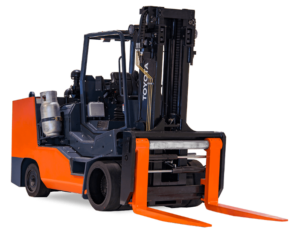
Operators have to actually practice operating the type of equipment they’ll be using on the job. This is where online-only programs consistently fall short. OSHA requires hands-on training on the actual equipment type, and that practice needs to reflect the actual conditions of your workplace. A video walkthrough or a simulator does not substitute for this component.
Evaluation in the Workplace
Before an operator works unsupervised, a qualified individual needs to evaluate their performance in the actual work environment — not in a parking lot, not in a generic warehouse, but at your facility on your floor with your equipment. This evaluation also needs to be repeated at least once every three years.
Our forklift operator certification guide goes into more detail on what each of these components involves and what the full process looks like from start to finish.
Why Generic or Online-Only Training Is Not Enough
This comes up constantly, so it is worth spending a moment on. OSHA’s standard is explicit that training has to be tailored to the specific hazards of the workplace where the operator will actually work. That includes things like the type of surface they will be driving on, load types and how they are stored, aisle widths and pedestrian traffic patterns, and the specific forklift model and its rated capacity.
An operator who completed a generic online course has covered the general knowledge material. But if they have never operated the specific type of forklift at your facility and have never been evaluated in your specific environment, they do not yet meet the full standard. The practical training and workplace evaluation still need to happen.
This is why our forklift safety training program is delivered directly at your location. Training that happens at your facility, on your equipment, in your actual operating environment is what OSHA’s standard is designed to produce.
Who Is Qualified to Conduct the Training
OSHA defines a qualified trainer as someone with the knowledge, training, and experience to train operators and evaluate their competence. But if you use an internal employee as your trainer, you need to be able to document their qualifications if OSHA asks.
Many employers choose to bring in a third-party provider specifically because it removes that ambiguity. When something goes wrong and there is an investigation, having a documented professional training program with a qualified external provider on record is a much cleaner position than pointing to an employee who just happens to know how to run the forklift. Your company and trainer are legally responsible for liability and lawsuits that may arise from improper safety training. Are you willing to assume the liability and lawsuit’s if they arise?
When Retraining Is Required
OSHA requires retraining when any of the following happen:
- License expiration date expires
- An operator is observed operating equipment unsafely
- An operator is involved in a near-miss or an accident
- An evaluation reveals the operator is not performing safely
- The operator is assigned to a different type of equipment
- Conditions in the workplace change in a way that affects safe operation
That last point catches a lot of employers off guard. If you reorganize your warehouse, change your racking layout, start handling a different type of product, or bring in a new piece of equipment, that can trigger a retraining obligation for affected operators. Building a relationship with a training provider you can call on short notice when these situations come up makes a real difference.
What You Need to Document
OSHA does not specify an exact retention period for forklift training records, but the broadly accepted best practice is to keep records for the full duration of an employee’s time with your company plus three years after they leave. At minimum your training documentation should include the operator’s name, the date training and evaluation were completed, the name of the person who conducted the training, and a statement confirming the operator was found competent.
Forklift Safety Training Florida provides each employer with a valid OSHA certification for every operator who completes training, along with documentation to support your compliance records.
A Note on Certification Renewal
While OSHA allows forklift operator certifications to last a maximum of three years, Forklift Safety Training Florida renews certifications every two years. We have found this schedule keeps operators sharper, reduces the risk of lapses in compliance, and helps employers stay ahead of requirements rather than scrambling to catch up. A three-year license is available upon reques Our forklift certification renewal guide covers how the renewal process works and what triggers an earlier renewal outside of the regular schedule.
Other Equipment That Requires Similar Training
Forklifts are not the only equipment covered under OSHA’s training requirements. If your operation uses aerial lifts or boom lifts, Scissor-lifts, Narrow Aisle equipment, skid steers or compact track loaders, or electric pallet jacks and walkie riders, similar compliance obligations apply. FST provides on-site OSHA-compliant training for all of these equipment types throughout Florida.
How FST Helps Florida Employers Stay Compliant
Forklift Safety Training Florida works with businesses across the state to make sure all three components of OSHA’s training standard are covered. Every program includes site-specific OSHA-compliant instruction delivered at your location, a written exam, a hands-on evaluation using your actual equipment, and a valid OSHA certification issued to each operator on the same day. Training is available in both English and Spanish.
We serve businesses throughout Florida including Daytona/Orlando, Jacksonville, Tampa, Fort Lauderdale, Miami, Melbourne, West Palm Beach, Pompano, and everywhere in between. We come to you.