Scissor Lift vs Boom Lift: Safety & Certification Summary
- Scissor lifts and boom lifts are both elevated work platforms — but they move differently, carry different fall protection requirements, and require separate OSHA-compliant training.
- Scissor lifts lift the platform straight up and down only. The platform stays directly over the base.
- Boom lifts extend the platform outward — horizontally and vertically — using either an articulating (jointed) or telescopic (straight) boom.
- Fall protection is the single biggest safety difference. Boom lift operators must wear a full-body harness with a lanyard attached to the platform at all times. Scissor lift operators usually rely on the platform’s guardrail system unless their employer requires additional fall protection.
- OSHA does not recognize a single “aerial lift certification” that covers both. Operators must be trained and evaluated on the specific type of equipment they will use.
- Bottom line: if you need to reach over an obstacle or out and up, you need a boom lift. If you need to go straight up in a fixed footprint, a scissor lift is simpler, safer, and cheaper to operate.
A construction superintendent in Jacksonville needs to reach a 35-foot signage installation behind landscaping. A maintenance manager in a Tampa distribution center needs to change overhead lighting in a 20-foot aisle. A telecom contractor in Miami needs to access a utility pole near a fence line. All three are elevated work problems. None of them have the same answer.
Scissor lifts and boom lifts are the two most common mobile elevated work platforms in Florida construction, industrial, utility, and warehouse work. They look related, both get called “aerial lifts” in casual conversation, and many people assume one certification covers both. OSHA disagrees on the second point, and your operators’ safety depends on the first.
This guide walks through how scissor lifts and boom lifts actually differ, mechanically, safely, and from an OSHA training perspective, and how Florida safety managers and operations leads decide which equipment fits which job.
What Is a Scissor Lift?
A scissor lift is a mobile elevated work platform that raises a platform straight up and straight down using a set of crisscrossing metal supports beneath the platform, the “scissor” mechanism that gives the equipment its name. The platform’s footprint stays directly over the equipment base throughout the entire lift range.
Because the platform stays centered over the base, scissor lift stability is consistent across the elevation range. The unit does not become more tip-prone as the platform rises, the way a boom lift does. This is a fundamental physics difference that drives many of the other safety and certification differences below.
Common Scissor Lift Types
- Electric scissor lifts — battery powered, non-marking tires, designed for indoor or smooth-surface outdoor use. The standard choice for warehouse maintenance and indoor construction.
- Rough terrain scissor lifts — diesel or LPG powered, pneumatic tires, outrigger stabilizers, designed for outdoor and uneven-surface use.
- Compact scissor lifts — narrow profiles for tight aisles and confined spaces where larger equipment cannot maneuver.
Where Scissor Lifts Are the Right Choice
- Indoor maintenance, retrofit work, electrical, lighting, HVAC
- Warehouse rack inspection, signage, and replacement work performed straight overhead
- Indoor construction trades, drywall, painting, ceiling work
- Any job where the work is directly above the unit’s footprint and a stable, predictable platform is needed
For more on what OSHA requires for scissor lift operation specifically, see our scissor lift certification page.
What Is a Boom Lift?
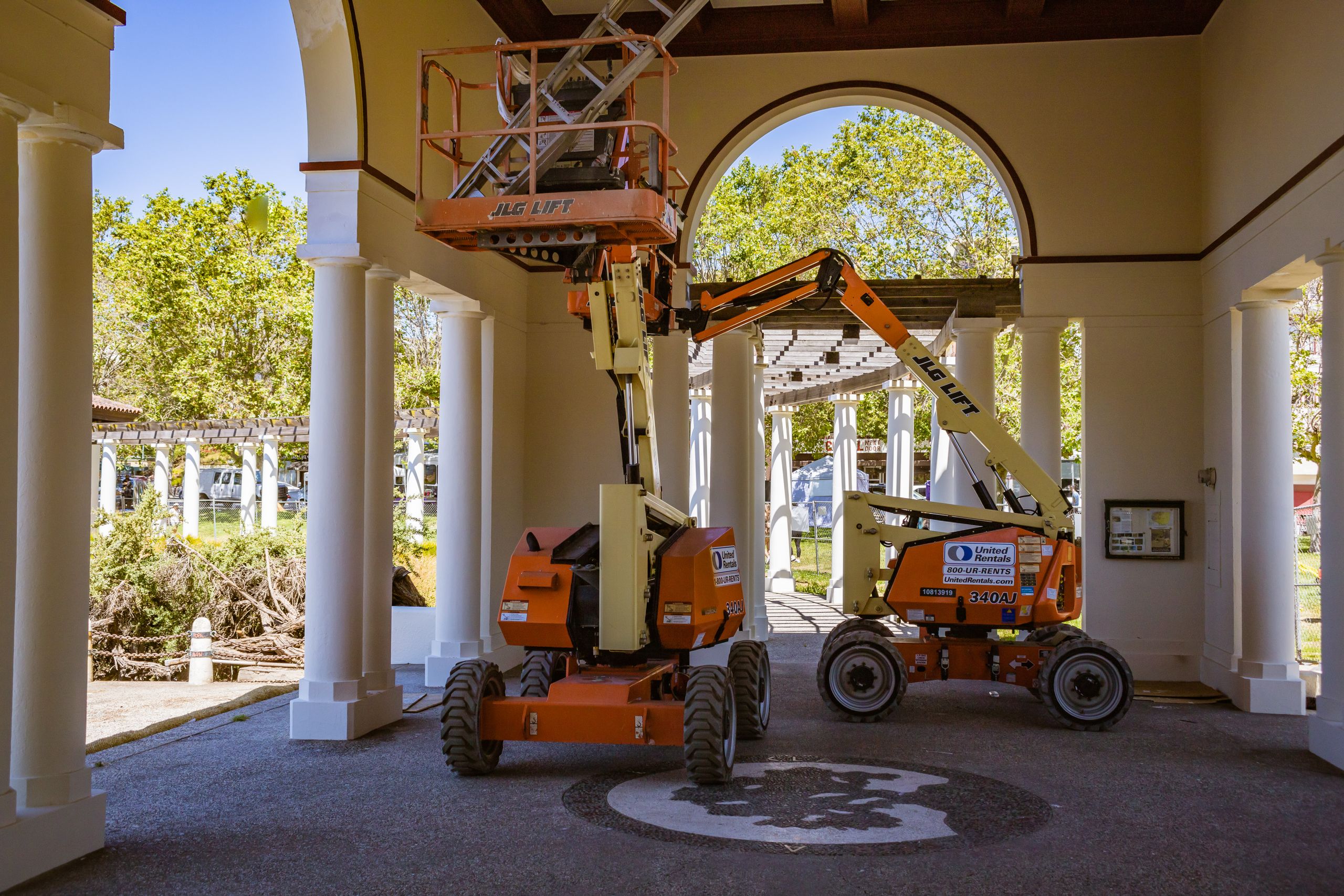
A boom lift is a mobile elevated work platform that extends a bucket or platform outward from the base on a powered boom. Unlike a scissor lift, the work platform does not stay over the unit’s footprint, it reaches up and out, with the boom providing both vertical and horizontal range.
Boom lifts come in two distinct mechanical configurations, and the difference matters for both job selection and operator training.
Articulating Boom Lifts
An articulating boom lift has a boom with one or more jointed sections, like a folded elbow that unfolds and bends. The boom can navigate up and around obstacles, reach over rooflines, work past landscaping, and access work positions a straight boom cannot. Articulating booms are the workhorse of construction, signage, exterior maintenance, and any application where the operator has to get around something to get to the work.
Telescopic (Straight) Boom Lifts
A telescopic boom lift, sometimes called a “straight boom” or “stick boom,” has a boom that extends straight out in a single line, like a fishing rod. Telescopic booms offer the longest horizontal reach in the aerial lift category, modern units can extend 100 feet or more. They are the standard choice when distance, not maneuverability, is the primary constraint. Common applications include utility line work, tall building exterior maintenance, large industrial sites, and ship maintenance at the major Florida ports.
Where Boom Lifts Are the Right Choice
- Any job requiring horizontal reach past an obstacle (landscaping, fences, equipment)
- Reaching over a structure to access the work
- Long-distance reach for utility, telecom, signage, or exterior facade work
- Work at heights where a scissor lift cannot physically reach
- Jobs in uneven outdoor terrain where boom-mounted platforms outperform scissor mechanisms
Florida Forklift Safety Training provides OSHA-compliant boom lift certification for both articulating and telescopic models, on-site at your facility or job site.
Scissor Lift vs Boom Lift: Side-by-Side Comparison
| Feature | Scissor Lift | Boom Lift |
|---|---|---|
| Platform movement | Vertical only (straight up/down) | Vertical AND horizontal (up/down and out) |
| Mechanism | Crisscrossing scissor supports | Articulating (jointed) or telescopic boom |
| Platform footprint | Stays directly over equipment base | Extends outward from base |
| Stability profile | Consistent across elevation range | Changes with boom angle and extension |
| Fall protection requirement | Guardrails (harness may be required by employer) | Full-body harness + lanyard ALWAYS required |
| Typical max working height | 20–60 feet (most units) | 30–100+ feet depending on type |
| Horizontal reach | None | Up to 80+ feet on large telescopic units |
| Power source | Usually electric (indoor) or diesel (rough terrain) | Usually diesel; some electric for indoor use |
| OSHA reference | 29 CFR 1910.23 (general industry) / 1926.451 (scaffold-style rules in construction) | 29 CFR 1926.453 (aerial lifts) |
| ANSI MEWP classification | Group A (platform stays over chassis) | Group B (platform extends beyond chassis) |
| Separate OSHA training required? | Yes | Yes |
| Same operator certification? | No — equipment-specific training required | No — equipment-specific training required |
The Single Biggest Safety Difference: Fall Protection
Of every difference on the comparison table, one matters more than the others for operator safety: fall protection.
Boom lift operators are required to wear a full-body harness with a lanyard secured to a manufacturer-approved anchor point on the platform, and that requirement applies any time the operator is in the platform, full stop. The reason is the equipment’s design. When a boom lift extends outward, the platform can be jolted by the boom’s hydraulic movement, by impact with an obstacle, by sudden wind loads, or by an unexpected stop. Operators have been ejected from boom lift platforms by movements that did not even tip the equipment. The harness is the only thing standing between an ejection event and a fatal fall.
Scissor lift fall protection rules are different. Because the platform stays over the base and is enclosed by guardrails on all sides, OSHA does not require operators to wear a harness while inside the guardrail system of a properly designed scissor lift. The guardrails are the primary fall protection system. Many employers — particularly in construction or where operators reach outside the guardrail, require harnesses anyway as a matter of company policy, and certain working positions (such as standing on a midrail) absolutely require fall arrest.
This distinction is the single most-violated piece of aerial lift compliance in Florida construction inspections. Operators trained on scissor lifts but assigned to a boom lift will, by default, behave as if the guardrails are their fall protection. They are not.
OSHA Training and Certification Requirements
OSHA treats scissor lifts and boom lifts under different standards, but the training principles are consistent — the operator must be trained on the specific equipment they will use, evaluated by a qualified trainer, and documented.
Scissor Lifts
OSHA generally treats scissor lifts as scaffold-style work platforms in 29 CFR 1910.23 for general industry and 29 CFR 1926.451 for construction, because the platform travels straight up and down on a fixed base. Training must cover the manufacturer’s operating instructions, fall protection and guardrail use, surface and slope limitations, wind and weather considerations, and proper movement and positioning procedures.
Boom Lifts
Boom lifts in construction operate under 29 CFR 1926.453 — Aerial Lifts. Training must cover all of the above plus the platform’s outboard reach behavior, boom positioning, working envelope limitations, the mandatory full-body harness and lanyard system, and emergency procedures for boom retraction or descent. The fall protection element gets a dedicated portion of every compliant boom lift training program.
ANSI A92 — Why It Matters in 2026
The ANSI A92.20-2018 standard reclassified what used to be called “aerial work platforms” as “Mobile Elevating Work Platforms,” or MEWPs. Under the new framework:
- Group A MEWPs — the platform stays within the equipment’s base footprint. Scissor lifts fall in Group A.
- Group B MEWPs — the platform can extend beyond the base footprint. Boom lifts fall in Group B.
OSHA has not formally adopted the ANSI A92.20 terminology into its standards, but the ANSI framework is the operational reality in modern equipment specs, rental contracts, and training curricula. Any contemporary aerial lift training program in Florida should be teaching the Group A / Group B distinction even where the regulatory citation still says “aerial lift.”
How to Choose: Scissor Lift or Boom Lift?
For most Florida jobs, the choice comes down to four questions.
- Do I need to reach out and around an obstacle? If yes, boom lift. Scissor lifts only go up.
- What is the maximum working height required? Scissor lifts top out around 50–60 feet for the largest units. Above that, boom lift.
- What is the surface like? Smooth, level indoor concrete favors electric scissor lifts. Uneven outdoor terrain, mud, gravel, or rough construction sites favor boom lifts or rough-terrain scissor lifts.
- What is the budget envelope? Scissor lifts are generally cheaper to rent or buy, simpler to operate, and require less specialized training. Pay the boom lift premium only when the job actually requires it.
A common misuse pattern in Florida construction: contractors default to boom lifts because they offer more flexibility, then assign the operator without verifying boom lift training. The result is an OSHA citation waiting to happen. The right answer is to match equipment to job — and make sure each operator’s certification matches the equipment.
Florida Applications
Florida’s geography and economy create distinct application zones for each type of equipment.
- Construction across the state — articulating boom lifts dominate for exterior facade work, roofing, and HVAC rooftop installations
- Utilities and telecom (FPL, Spectrum, AT&T contractors) — telescopic boom lifts for line work and high-distance reach
- Major Florida port operations (Miami, Jacksonville, Tampa, Port Everglades) — boom lifts for ship maintenance and crane work, scissor lifts for indoor terminal maintenance
- Distribution centers (Lakeland, Orlando I-4 corridor) — scissor lifts for overhead rack maintenance, lighting, and HVAC service
- Sign and graphics installers (statewide) — boom lifts for highway signage and dimensional letters above storefronts
- Theme park and tourism maintenance — both, depending on the structure
- Manufacturing facilities (Tampa Bay, Jacksonville) — scissor lifts dominate for overhead production-line maintenance
The common requirement across all of them: operators trained and certified on the specific equipment, evaluated on the specific workplace.
Frequently Asked Questions
What is the difference between a scissor lift and a boom lift?
A scissor lift raises a platform straight up and down using crisscrossing supports beneath the platform — the platform stays directly over the equipment base. A boom lift extends a platform outward and upward on an articulating (jointed) or telescopic (straight) boom, allowing horizontal reach beyond the equipment base. The mechanical difference drives every other safety, training, and application difference between the two.
Do you need fall protection on a scissor lift?
OSHA’s primary fall protection on a properly designed scissor lift is the guardrail system around the platform. Operators are not required by federal standard to wear a personal fall arrest harness while inside the guardrails of a compliant scissor lift. Many employers and most construction sites require harnesses anyway as a matter of policy. Operators who lean out beyond the guardrails or stand on the midrail must use fall protection.
Do you need a harness on a boom lift?
Yes. Per 29 CFR 1926.453, every boom lift operator must wear a full-body harness with a lanyard attached to a manufacturer-approved anchor point on the platform. The requirement is in effect any time the operator is in the platform, not just during boom movement.
Can I use my scissor lift certification on a boom lift?
No. OSHA requires equipment-specific training and evaluation. The mechanical differences, fall protection requirements, stability profiles, and operating envelopes between scissor lifts and boom lifts are significant enough that one certification does not transfer to the other. Operators who will use both types of equipment need separate training and a certification record that reflects both.
What is an articulating boom lift?
An articulating boom lift has a jointed boom — typically with one or more elbow-style hinges — that allows the platform to move around obstacles instead of just out from the base. Articulating booms are the most common boom lift type in construction and maintenance work because they can reach past landscaping, over rooflines, and into work positions a straight boom cannot.
Are boom lifts and aerial lifts the same thing?
The terms are often used interchangeably in casual conversation, but they are not identical. “Aerial lift” is a broader OSHA-recognized category that historically includes boom-supported elevating work platforms (boom lifts), aerial ladders, articulating tower platforms, vertical towers, and similar equipment. “Boom lift” specifically refers to platforms supported by a boom — articulating or telescopic. Under the ANSI A92.20 framework, both belong in the Group B MEWP category. For a broader comparison covering the whole aerial lift category against scissor lifts, see our aerial lift vs scissor lift article.
Get Florida Operators Certified on the Right Equipment
The wrong certification on the right equipment is just as much an OSHA violation as no certification at all. Florida construction sites, distribution centers, ports, and manufacturing facilities run on both scissor lifts and boom lifts — and many operators rotate between the two depending on the job.
Florida Forklift Safety Training delivers OSHA-compliant scissor lift and boom lift certification on-site at your facility or job site, in English or Spanish, across the entire state. With more than 60 years of materials handling and aerial work experience, we train operators on the equipment they will actually use — including articulating booms, telescopic booms, electric and rough terrain scissor lifts.
Offices in Daytona Beach, Miami, Fort Lauderdale, Pompano Beach, West Palm Beach, Fort Myers, and Tampa.
- Main office (Central Florida & all other counties): 386-492-7852
- Miami-Dade & Monroe: 305-460-0133
- Palm Beach, Pompano, Ft. Lauderdale: 954-270-2799
Contact us to schedule scissor lift or boom lift training, or visit our aerial lift certification page for course details. Pick the equipment that fits the job. Train the operator for the equipment. Document the certification. That sequence prevents both citations and incidents.