Aerial lifts and scissor lifts both elevate workers to perform tasks at height, but these equipment categories have distinct operational characteristics, safety requirements, and certification needs. Understanding the differences between these machines helps Florida employers ensure their operators receive appropriate training while maintaining OSHA compliance. The confusion between these equipment types can lead to inadequate training that puts workers at risk and creates compliance violations during inspections.
Understanding the Basic Equipment Differences
Before diving into certification requirements, it’s essential to understand what distinguishes aerial lifts from scissor lifts. While both belong to the broader category of aerial work platforms (AWPs), their mechanical designs, operational capabilities, and hazard profiles differ significantly.
What Are Aerial Lifts?
Aerial lifts represent equipment with articulating or telescoping booms that extend outward and upward to position workers at elevated locations. These machines include boom lifts, cherry pickers, bucket trucks, and articulating platforms that can reach over obstacles, around obstructions, and to positions that can’t be accessed vertically.
Boom lifts feature telescoping booms that extend straight out from the base, providing maximum reach for accessing distant elevated work areas. These machines excel at reaching building facades, outdoor signage, or work positions requiring horizontal reach combined with vertical elevation.
Articulating boom lifts (often called “knuckle booms”) include multiple boom sections connected by joints that bend, allowing the platform to navigate around obstacles and position workers in locations inaccessible to straight-boom equipment. This articulation capability makes them ideal for working around structural elements or in congested industrial environments.
Boom trucks mount aerial work platforms on vehicle chassis, combining transportation capability with elevated access. These versatile machines serve utility companies, telecommunications installers, and contractors requiring mobile elevated work capability across job sites.
The defining characteristic of all aerial lifts is their ability to position workers horizontally away from the equipment base through boom extension and articulation. This outreach capability creates unique stability challenges and operational considerations that don’t apply to vertical-only equipment.
What Are Scissor Lifts?
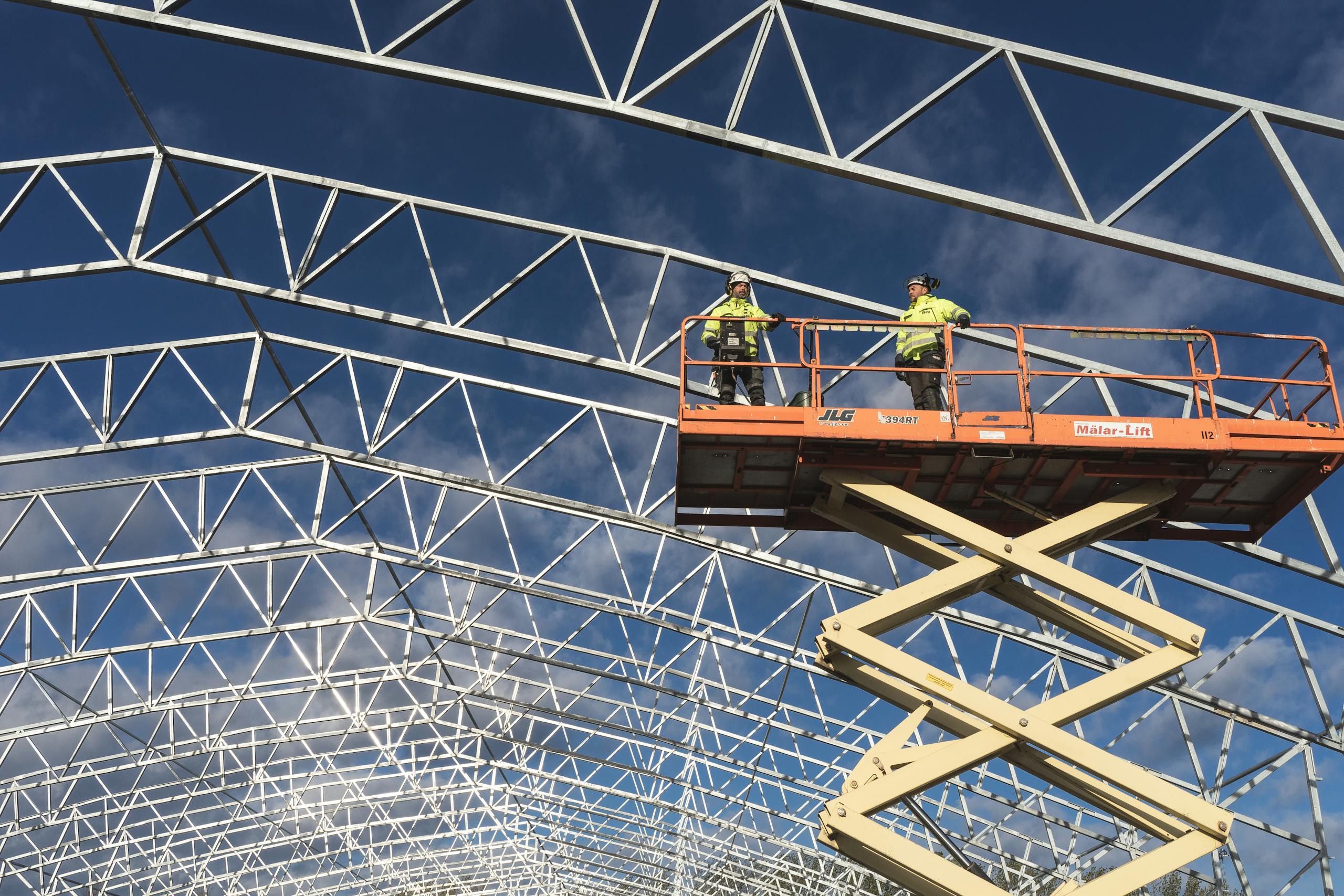
Scissor lifts use crisscrossing metal supports that extend vertically to raise a work platform straight up and down. Unlike aerial lifts, scissor lifts cannot extend horizontally—the platform moves only in the vertical plane directly above the base.
Electric scissor lifts operate indoors on smooth, level surfaces using battery power and non-marking tires. These quiet, emission-free machines dominate warehouse maintenance, retail installations, and indoor construction applications where clean operation is essential.
Rough terrain scissor lifts feature larger pneumatic tires, four-wheel drive, and enhanced ground clearance for outdoor use on unimproved surfaces. These machines handle construction sites, outdoor maintenance, and applications where standard indoor models can’t operate safely.
Compact scissor lifts provide narrow profiles for working in tight spaces like aisles or between equipment. Their small footprint and vertical-only movement make them ideal for congested environments where boom lifts can’t maneuver.
The vertical-only movement of scissor lifts creates a fundamentally different stability profile than boom-extended aerial lifts. The platform remains centered over the base throughout the elevation range, maintaining consistent stability that doesn’t vary with boom position or extension distance.
Key Operational Distinctions
The most significant operational difference between aerial lifts and scissor lifts relates to reach capability and how that affects equipment use. Aerial lifts access work positions offset from the equipment base, requiring operators to manage boom angles, extension distances, and platform positioning relative to obstacles. Scissor lifts provide stable platforms for vertical access but require the entire machine to be positioned directly beneath work areas.
This fundamental difference affects fall protection requirements, stability management, positioning procedures, and the hazards operators must recognize and control. Training that treats these machines as interchangeable equipment fails to address critical distinctions that affect safe operation.
OSHA Standards: Different Regulations Apply
Understanding which OSHA standards govern each equipment type explains why certification requirements differ. The regulations applying to aerial lifts and scissor lifts address different hazard profiles and operational concerns.
Aerial Lifts: OSHA 1926.453
OSHA Standard 1926.453 specifically addresses aerial lifts, establishing requirements for equipment design, operator qualifications, and safe operating procedures. This construction industry standard applies to all aerial lift operations regardless of industry sector—manufacturing facilities, warehouses, and retail operations must comply with 1926.453 when using aerial lifts even though they’re not construction sites.
The regulation defines aerial lifts as vehicle-mounted devices used to elevate personnel to job sites above ground, including extensible boom platforms, aerial ladders, articulating boom platforms, vertical towers, and combinations of these devices. The defining characteristic is the boom or articulating mechanism that extends the platform away from the vehicle or base.
Key requirements under 1926.453 include mandatory body harness use connected to the boom or basket, specific operator training on equipment limitations and hazards, procedures preventing accidental boom movement during positioning, and restrictions on modifications unless approved by manufacturers. These requirements recognize the unique fall hazards and stability challenges created by boom extension.
Scissor Lifts: OSHA 1926.451 and 1926.452
Scissor lifts fall under OSHA scaffolding standards 1926.451 and 1926.452 rather than the aerial lift standard. OSHA classifies scissor lifts as mobile scaffolds—a distinction with significant implications for fall protection and operational requirements.
Under scaffolding standards, fall protection requirements differ from aerial lifts. Guardrails meeting specific height and strength requirements provide primary fall protection on scissor lifts, with personal fall arrest systems required only in specific circumstances rather than for all elevated operations.
This regulatory classification reflects the different hazard profile of vertical-only equipment with platforms that remain centered over bases throughout their elevation range. The stable platform provided by properly used scissor lifts differs fundamentally from boom-extended aerial lift platforms that may experience greater movement and instability.
Why the Regulatory Distinction Matters
The different OSHA standards applying to these equipment categories create distinct compliance obligations affecting training content, fall protection requirements, and operational procedures. Employers who treat all elevated work platforms as interchangeable equipment miss critical regulatory distinctions that affect both compliance and safety.
Aerial lift training must address boom extension hazards, platform positioning techniques, and body harness requirements specific to 1926.453. Scissor lift certification focuses on vertical positioning, guardrail integrity, and mobile scaffold considerations under 1926.451 and 1926.452.
Attempting to certify operators for both equipment types through single generic “elevated work platform” training fails to address the specific requirements of each OSHA standard and the distinct operational characteristics of each equipment category.
Training Requirements: Similarities and Critical Differences
Both aerial lifts and scissor lifts require operator training before workers operate equipment independently. However, the content, emphasis, and specific competencies differ based on equipment characteristics and regulatory requirements.
Common Training Elements
Regardless of equipment type, elevated work platform training must include formal instruction covering equipment capabilities and limitations, pre-operational inspection procedures, recognition of workplace hazards affecting safe operation, emergency procedures including rescue planning, and site-specific conditions affecting equipment use.
Practical training providing hands-on experience with actual equipment remains essential for both categories. Operators need experience with real equipment responses, control systems, and operational challenges that can’t be adequately conveyed through classroom instruction alone.
Performance evaluation verifying operator competency must occur before workers operate either equipment type independently. Trainers observe operators performing inspections, demonstrating safe operating procedures, and responding appropriately to simulated hazard scenarios.
Aerial Lift-Specific Training Components
Aerial lift training must emphasize boom positioning and extension management—skills irrelevant to vertical-only scissor lift operation. Operators need to understand how boom angle affects stability, how extension distance influences safe working limits, and how to position platforms safely relative to obstacles and overhead hazards.
Fall protection using body harnesses and lanyards represents a critical aerial lift training element. Operators must learn proper harness fitting, attachment point selection, lanyard length management, and procedures ensuring continuous connection during platform occupation.
Outrigger deployment and stabilization procedures apply to many boom lift configurations. Training must cover ground condition assessment, proper outrigger positioning, verification of secure deployment, and understanding how inadequate stabilization creates tip-over risks.
Emergency descent procedures specific to boom lift designs address situations where hydraulic failure or power loss requires manual lowering. These procedures vary by manufacturer and model, requiring equipment-specific instruction rather than generic emergency response training.
Scissor Lift-Specific Training Components
Scissor lift training emphasizes positioning the entire machine beneath work areas since the platform cannot extend horizontally. Operators learn to assess floor surfaces, navigate to work positions, and position equipment precisely for vertical access to work areas.
Guardrail integrity and platform security receive particular attention in scissor lift training. Operators must understand the importance of intact guardrails, proper gate closure, and procedures preventing platform access when guardrails are compromised or removed.
Surface condition assessment becomes critical for rough terrain scissor lift operation. Training addresses grade limitations, soft ground recognition, and surface conditions where operation creates unacceptable tip-over risks. Indoor scissor lift training emphasizes smooth surface requirements and restrictions on ramp or slope use.
Load distribution on scissor lift platforms affects stability differently than on boom lifts. Training addresses proper material placement, maximum platform loads, and recognition of loading conditions that create stability concerns or overload risks.
Equipment-Specific vs. Category Training
Effective training addresses specific models and configurations operators will use rather than providing only generic equipment category instruction. Control layouts, operational characteristics, and safety features vary between manufacturers and even between models from the same manufacturer.
Training on one boom lift model doesn’t automatically transfer to proficiency on articulating boom lifts with fundamentally different control systems and operational characteristics. Similarly, electric scissor lift training doesn’t fully prepare operators for rough terrain models with four-wheel drive, oscillating axles, and outdoor operational considerations.
Employers must ensure training covers the actual equipment operators will use. Construction equipment training that addresses multiple equipment types in single sessions often fails to provide adequate depth on any specific category, leaving operators unprepared for the actual machines they’ll operate.
Fall Protection Requirements: The Critical Distinction
Fall protection represents one of the most significant differences between aerial lift and scissor lift operation. Understanding these requirements prevents serious citations during OSHA compliance inspections and, more importantly, protects workers from falls.
Aerial Lift Fall Protection Mandates
OSHA 1926.453(b)(2)(v) explicitly requires aerial lift operators to use body harnesses with lanyards attached to the boom or basket. This mandatory personal fall arrest system requirement applies to all aerial lift operations without exception—guardrails alone don’t satisfy fall protection requirements for boom lifts.
The body harness must meet ANSI standards for fall arrest equipment, with lanyards appropriately rated and in good condition. Attachment must be to the boom or basket rather than to adjacent structures, preventing situations where boom movement creates fall hazards through inappropriate attachment points.
Lanyard length must limit free fall distance to prevent operators from falling below platform levels or striking lower structures during falls. Short lanyards that restrict movement less than longer configurations provide optimal protection while allowing necessary mobility for work tasks.
This mandatory harness requirement recognizes that aerial lift platforms experience greater movement, less stability, and higher fall risks than vertical-only scissor lift platforms. The extended boom creates leverage that can amplify base movement, while positioning near building edges or other fall hazards increases consequences of platform departure.
Scissor Lift Fall Protection Approaches
Scissor lifts require guardrails meeting OSHA fall protection standards—top rails at 42 inches, mid-rails, and toeboards providing barrier protection around platform perimeters. These guardrails serve as primary fall protection, with personal fall arrest systems required only in specific circumstances.
OSHA requires personal fall arrest systems on scissor lifts when guardrails are removed or opened, when working from scissor lift platforms near unprotected edges where falls exceed six feet, or when manufacturer guidelines specify harness use for particular operations or conditions.
Many employers implement more stringent policies requiring harness use on all elevated work platforms regardless of equipment type. While exceeding OSHA minimums, these policies simplify training and eliminate judgment calls about when harnesses are required. However, understanding the actual regulatory requirements helps employers make informed policy decisions.
The less stringent fall protection requirements for scissor lifts reflect their more stable platform design and vertical-only movement that maintains consistent positioning relative to the base. This doesn’t mean scissor lifts are inherently safer—falls from any elevated platform can cause serious injuries—but the hazard profile differs from boom-extended equipment.
Common Fall Protection Violations
The most frequent fall protection citations involving aerial work platforms include operating boom lifts without body harnesses, improper harness attachment to structures rather than boom or basket, using worn or damaged fall arrest equipment, and removing or bypassing guardrails on scissor lifts without implementing alternative fall protection.
Training must emphasize that fall protection isn’t optional based on operator comfort or perceived stability. The requirements exist because falls from elevated platforms consistently cause serious injuries and fatalities—workplace accident prevention depends on consistent adherence to fall protection requirements regardless of how secure operators feel.
Stability Considerations: Equipment-Specific Challenges
Understanding how each equipment type maintains stability helps explain different operational procedures and restrictions that training must address. The stability challenges differ significantly between aerial lifts and scissor lifts.
Aerial Lift Stability Dynamics
Boom extension creates a cantilevered load that affects equipment stability as extension distance increases. The extended boom, platform, occupants, and tools create a moment arm that can overcome base stability when extended beyond safe limits or used on inadequate surfaces.
Load charts specific to each aerial lift model indicate safe working ranges based on boom angle, extension distance, platform loading, and base configuration. Operators must understand how to read load charts and recognize when operational conditions require restrictions beyond normal capabilities.
Wind effects on extended booms create additional stability challenges. High surface area of extended booms and platforms catches wind, creating forces that can destabilize equipment even when stationary. Training must address wind speed thresholds where operations should cease and procedures for securing equipment during high wind conditions.
Outrigger deployment, when available, significantly affects stability by widening the support base beyond the equipment’s travel configuration. Proper deployment requires level positioning, adequate ground support, and verification that outriggers achieve specified loading. Inadequate deployment negates their stabilizing benefit and may create false security.
Scissor Lift Stability Profile
Scissor lifts maintain their center of gravity within the base footprint throughout elevation range, providing consistent stability that doesn’t vary significantly with platform height. This stability advantage over boom lifts allows operation with less stringent positioning requirements and simpler stability assessment.
However, scissor lifts remain vulnerable to tip-overs when used on slopes beyond rated capacities, when positioned on soft ground that settles under load, or when side forces from pulling or pushing on structures create lateral instability. Training must address these scenarios even though vertical-only movement generally provides superior stability.
Platform loading affects scissor lift stability when loads create eccentric center of gravity or when total loads exceed platform ratings. Materials, tools, and multiple workers on platforms must be distributed appropriately and kept within weight limits marked on equipment.
Extended deck sections available on some scissor lift models change stability characteristics by moving the center of gravity away from the base centerline. Operators need specific training on models with extending platforms that create different stability profiles than fixed-platform designs.
Surface Requirements and Restrictions
Both equipment types require firm, level surfaces, but the specific requirements and tolerances differ. Aerial lifts with outriggers can operate on somewhat uneven terrain when outriggers are properly deployed, while scissor lifts require more consistently level surfaces due to their fixed base configuration.
Grade limitations clearly marked on equipment indicate maximum slopes where safe operation is possible. These ratings differ between equipment types and models, requiring operators to understand limitations of specific equipment they use rather than applying generic rules across all elevated platforms.
Indoor vs. outdoor surface considerations affect equipment selection and operational procedures. Smooth warehouse floors provide ideal operating surfaces for electric scissor lifts, while outdoor construction sites may require rough terrain configurations or boom lifts that can extend over surface irregularities.
Certification Process: Steps for Each Equipment Type
While the overall certification process follows similar patterns for aerial lifts and scissor lifts, specific implementation details differ based on equipment characteristics and regulatory requirements.
Initial Training and Evaluation
Comprehensive training begins with formal instruction covering the equipment type, operational principles, hazard recognition, and safe operating procedures. This classroom component provides foundational knowledge before operators touch equipment.
Practical training allows operators to experience actual equipment operation under instructor supervision. This hands-on component builds skill and confidence while allowing trainers to identify and correct technique problems before they become ingrained habits.
Performance evaluation verifies that operators can safely operate equipment independently. Evaluation must occur in workplace conditions or environments closely simulating actual operations, ensuring operators can apply training to real-world situations.
Equipment-Specific Considerations
Operators certified on boom lifts are not automatically qualified for articulating boom lifts—the different control systems and operational characteristics require specific training on each configuration. Similarly, electric scissor lift certification doesn’t transfer to rough terrain models without additional training.
Multi-equipment certification becomes necessary when facilities use various aerial work platform types. Strategic training approaches can build on foundational knowledge while adding equipment-specific elements, but each distinct equipment category requires separate certification.
Documentation Requirements
Training records must identify specific equipment types covered in certification, not just generic “aerial work platform” designations. Documentation should clearly indicate whether operators are certified for boom lifts, articulating lifts, scissor lifts (indoor or rough terrain), or other specific configurations.
Certification cards or badges displaying equipment type icons help supervisors quickly verify operator qualifications for equipment being used. Visual identification systems prevent unauthorized equipment use and support consistent compliance.
Industry-Specific Applications and Training Needs
Different industries use aerial lifts and scissor lifts in distinct applications that affect training emphasis and operational priorities. Understanding how your industry uses elevated work platforms helps identify relevant training focus.
Construction and Contractors
Construction sites use both equipment types extensively, often on the same project. Contractors need operators certified on rough terrain scissor lifts for site work, boom lifts for building facade access, and potentially articulating lifts for work around structural elements or in congested areas.
Multi-equipment certification common in construction creates training challenges requiring efficient approaches that address multiple categories without shortchanging critical equipment-specific content. Sequential training building from simpler to more complex equipment types helps operators develop systematic understanding.
Site-specific training addressing particular project hazards, site layout, and coordination with other trades becomes essential for construction applications. Generic training divorced from actual job site conditions fails to prepare operators for real operational challenges.
Warehousing and Distribution
Warehouse operations primarily use electric scissor lifts for maintenance, installation, and inventory access at height. Indoor environments with smooth floors and climate control create ideal operating conditions for standard scissor lift configurations.
Training emphasis for warehouse applications focuses on positioning accuracy, pedestrian awareness in active facilities, and coordination with material handling equipment operations. These operational priorities differ from outdoor construction applications requiring attention to weather, surface conditions, and site logistics.
Maintenance and Facilities Management
Facilities maintenance operations may require both aerial lifts for exterior building work and scissor lifts for interior maintenance tasks. Maintenance departments benefit from multi-equipment certification allowing versatile response to varying maintenance needs.
Infrequent equipment use common in maintenance applications makes refresher training particularly important. Operators who use equipment monthly rather than daily benefit from more frequent renewal than those operating equipment constantly.
Utilities and Telecommunications
Utility companies extensively use boom trucks combining vehicle-mounted aerial lifts with transportation capability. These applications require operators to hold both commercial driver’s licenses and aerial lift certification, creating more complex qualification requirements.
Utility applications often involve work near energized power lines, creating electrical hazards requiring specific training beyond standard aerial lift instruction. Minimum approach distances, insulated equipment requirements, and emergency procedures for electrical contact become critical training elements.
Choosing Between Aerial Lifts and Scissor Lifts
Understanding equipment differences helps employers select appropriate equipment for specific applications. The choice between aerial lifts and scissor lifts affects both operational efficiency and training requirements.
When Aerial Lifts Are the Right Choice
Aerial lifts excel at applications requiring horizontal reach over obstacles, access to building facades or outdoor signage, work positions offset from accessible ground locations, and capability to navigate around obstructions or structural elements.
The outreach capability of boom lifts allows work from stable base positions rather than requiring equipment positioning directly beneath work areas. This advantage becomes critical when ground conditions, obstacles, or access limitations prevent direct positioning.
When Scissor Lifts Provide Better Solutions
Scissor lifts work best for vertical access applications including ceiling work or overhead installations, maintenance tasks directly above accessible floor space, indoor applications where emission-free operation is required, and situations requiring stable work platforms for extended duration tasks.
The large, stable platform of scissor lifts provides superior workspace compared to the smaller baskets of most boom lifts. When work involves multiple workers or substantial tools and materials, scissor lift platforms offer advantages over boom lift configurations.
Cost and Training Implications
Aerial lifts typically cost more to rent or purchase than scissor lifts of comparable working height. Training costs also tend to be higher for boom lift certification due to more complex operational requirements and fall protection mandates.
Scissor lifts’ simpler operation and lower training requirements make them economical choices when their vertical-only movement adequately serves operational needs. However, attempting to use scissor lifts for applications requiring horizontal reach creates inefficiency and potential safety issues.
Common Mistakes and Misconceptions
Several common errors appear repeatedly in aerial work platform operations, often stemming from inadequate understanding of equipment differences and regulatory requirements.
Interchangeable Equipment Assumption
Treating all elevated work platforms as interchangeable equipment leads to operators using equipment they haven’t been trained on, applying scissor lift procedures to boom lift operations, or ignoring equipment-specific limitations and capabilities.
Each equipment category and configuration requires specific training addressing its unique operational characteristics, control systems, and hazard profile. Certification on one type doesn’t transfer to other categories without additional equipment-specific instruction.
Fall Protection Confusion
Misunderstanding fall protection requirements leads to boom lift operation without harnesses, inappropriate harness attachment to structures rather than booms, or unnecessary harness requirements on properly guarded scissor lifts when not required by regulations or manufacturer guidelines.
Clear training on regulatory requirements for each equipment type prevents these common violations. Employers should establish policies clarifying expectations while ensuring operators understand actual OSHA requirements underlying those policies.
Stability Misjudgments
Operators often misjudge stability limitations, operating equipment on slopes exceeding ratings, extending booms beyond safe working ranges, or positioning equipment on inadequate surfaces without recognizing ground condition hazards.
Training must build judgment skills through realistic scenarios and examples rather than just listing rules. Operators need to understand why limitations exist and what happens when they’re exceeded, not just memorize prohibited actions.
Florida-Specific Considerations for Aerial Work Platform Operations
Florida’s climate, building types, and industries create unique considerations for aerial lift and scissor lift operations that training should address.
Weather Challenges
Florida’s frequent thunderstorms create lightning hazards for elevated work platform operations. Training should address weather monitoring, criteria for suspending operations, and procedures for securing equipment during approaching storms.
High winds during storm events and hurricane season create stability concerns for extended boom lifts. Understanding wind speed limitations and procedures for ceasing operations during high wind conditions protects operators from preventable tip-over accidents.
Intense heat and humidity affect operator alertness and comfort during extended elevated operations. Training should address heat stress recognition, hydration requirements, and the importance of breaks during hot weather operations.
Hurricane Season Preparations
Equipment securing during hurricane season requires specific procedures for positioning, securing, and protecting aerial work platforms. While not traditional operational training, awareness of these procedures helps operators understand their roles during emergency preparations.
Post-hurricane operations involve heightened hazards including damaged structures, downed power lines, and debris creating obstacles. Operators need enhanced hazard awareness and communication protocols when returning to operations after major weather events.
Coastal and High-Rise Applications
Florida’s extensive coastline and high-rise construction create applications where boom trucks and large boom lifts access building exteriors for construction, maintenance, and window cleaning. These applications often involve operation near occupied buildings, requiring additional awareness and communication procedures.
Saltwater exposure accelerates corrosion on equipment used near coastal areas. Training should emphasize importance of thorough inspections, reporting of corrosion-related deterioration, and understanding how coastal environments affect equipment condition.
Implementing Compliant Training Programs
Successful aerial work platform training programs require systematic approaches addressing both aerial lift and scissor lift categories while recognizing their distinct requirements.
Assessment and Planning
Begin by inventorying aerial work platforms in your facility or used in your operations. Categorize equipment types, identify which employees need certification on which equipment categories, and assess current training status to identify gaps.
Evaluate operational applications to determine training emphasis appropriate for actual equipment uses. Construction applications differ from warehouse maintenance uses, requiring adjusted training focus even for the same equipment types.
Training Delivery Options
On-site training using your actual equipment in your work environment provides optimal preparation for operators. This approach addresses equipment-specific characteristics, site conditions, and operational procedures directly applicable to daily work.
Professional training providers like Forklift Safety Training Florida deliver comprehensive aerial lift and scissor lift certification addressing regulatory requirements and equipment-specific operations. Our training includes instruction, policy and procedure, safe use, inspections, maintenance, written exam, and hands-on evaluation. Valid OSHA certification issued. Our certified trainers provide site-specific OSHA-compliant instruction. English & Spanish available.
Ongoing Compliance Management
Implement systems tracking certification status, renewal dates, and training history for all operators. Automated reminders for approaching renewal deadlines prevent situations where operators work with expired certifications.
Conduct periodic observation of operator performance to verify continued adherence to safe practices. Address observed deficiencies through refresher training rather than waiting for accidents to trigger training requirements.
Maintain documentation proving training compliance including training records, equipment-specific certifications, and evaluation results. These records demonstrate systematic safety management during OSHA inspections or accident investigations.
Conclusion
Aerial lifts and scissor lifts serve distinct purposes and require different certification approaches reflecting their unique operational characteristics and regulatory requirements. Understanding these differences helps Florida employers implement appropriate training programs that genuinely prepare operators for safe equipment operation while ensuring OSHA compliance.
The regulatory distinction between OSHA 1926.453 for aerial lifts and scaffolding standards for scissor lifts creates specific compliance obligations affecting training content, fall protection requirements, and operational procedures. Generic “elevated work platform” training that doesn’t address these equipment-specific requirements leaves operators unprepared and employers vulnerable to citations.
Effective training addresses the actual equipment operators will use, workplace conditions where operation occurs, and specific applications for which equipment is employed. Equipment-specific instruction combined with site-specific elements creates competent operators who understand both how to operate equipment and how to do so safely in their particular work environment. Don’t compromise on aerial work platform training by treating fundamentally different equipment types as interchangeable. Invest in equipment-specific certification that addresses the unique requirements of both aerial lifts and scissor lifts. Contact Forklift Safety Training Florida today to implement comprehensive training programs that ensure compliance, enhance safety, and prepare operators for the real operational challenges they’ll encounter.